Encoder
Each encoder layer contains:
Self-Attention:
Captures relationships within the sequence.
Feedforward Network (FFN):
Two linear layers with a ReLU/GELU activation in between.
Add & Normalize:
Residual connection and layer normalization.

Self-Attention
Self-Attention Mechanism
Self-attention enables each token in the input sequence to attend to every other token in the sequence.
Step 1: Compute Three Vectors for Each Token
Query (𝑄): What the token wants to know.
Key (𝐾): How relevant a token is for answering.
Value (𝑉): The content of the token.
Step 2: Calculate Attention Scores
The attention score is computed as follows:
Where:
\(softmax\) ensures the scores are normalized.
\(d_k\) is the scaling factor to stabilize gradients.
[31]:
import os
import sys
# Add the parent directory of `TransformerNNX` to the Python path
sys.path.insert(0, os.path.abspath(os.path.join(os.getcwd(), "../../..")))
[32]:
import jax
import jax.numpy as jnp
from typing import Optional, Tuple, List
import matplotlib.pyplot as plt
from flax import nnx
from model import utils
[33]:
def scaled_dot_product(
    q: jnp.ndarray,
    k: jnp.ndarray,
    v: jnp.ndarray,
    mask: Optional[jnp.ndarray] = None,
) -> Tuple[jnp.ndarray, jnp.ndarray]:
    """
    Compute scaled dot-product attention.

    Args:
        q: Query tensor of shape (..., seq_len, d_k).
        k: Key tensor of shape (..., seq_len, d_k).
        v: Value tensor of shape (..., seq_len, d_k).
        mask: Optional mask tensor of shape (..., seq_len, seq_len).

    Returns:
        values: Tensor of shape (..., seq_len, d_k) containing the attention-weighted values.
        attention: Tensor of shape (..., seq_len, seq_len) containing attention scores.
    """
    d_k = q.shape[-1]  # Dimensionality of key vectors
    attn_logits = jnp.matmul(q, jnp.swapaxes(k, -2, -1))  # Compute attention logits
    attn_logits = attn_logits / jnp.sqrt(d_k)  # Scale by sqrt(d_k)

    if mask is not None:
        attn_logits = jnp.where(mask == 0, -1e9, attn_logits)  # Apply mask with large negative value

    attention = jax.nn.softmax(attn_logits, axis=-1)  # Softmax over last axis
    values = jnp.matmul(attention, v)  # Compute weighted values
    return values, attention
[34]:
key = jax.random.PRNGKey(0)

# Define dimensions
seq_len = 5
d_k = 4  # Dimensionality of the key/query/value vectors

# Create random tensors for q, k, v
q = jax.random.normal(key, (1, seq_len, d_k))  # Query tensor of shape (1, seq_len, d_k)
k = jax.random.normal(key, (1, seq_len, d_k))  # Key tensor of shape (1, seq_len, d_k)
v = jax.random.normal(key, (1, seq_len, d_k))  # Value tensor of shape (1, seq_len, d_k)

# Optional mask encoding matrix
mask = jnp.tril(jnp.ones((seq_len, seq_len)), k=0)

# Test the function
values, attention = scaled_dot_product(q, k, v, mask=mask)

# Check the shape of the output
print(f"Output values shape: {values.shape}")
print(f"Attention shape: {attention.shape}")
plt.figure(figsize=(8, 6))
plt.imshow(attention[0], cmap="viridis", interpolation="nearest")
plt.colorbar()
plt.title("Attention Matrix")
plt.xlabel("Sequence Position (Key)")
plt.ylabel("Sequence Position (Query)")
plt.show()

# Plot the values (weighted sum of value vectors)
plt.figure(figsize=(8, 6))
plt.imshow(values[0], cmap="viridis", interpolation="nearest")
plt.colorbar()
plt.title("Weighted Values (Result of Attention)")
plt.xlabel("Sequence Position")
plt.ylabel("Embedding Dimension")
plt.show()
Output values shape: (1, 5, 4)
Attention shape: (1, 5, 5)


Multi-Head Attention
Instead of using a single attention mechanism, Multi-Head Attention splits the query, key, and value vectors into multiple “heads”:
Split \(Q, K, V\) into multiple heads.
Perform attention for each head independently.
Concatenate the results and project back to the original model dimension.
[35]:
class MultiHeadAttention(nnx.Module):
    """
    Implements a multi-head attention mechanism.

    Attributes:
    ----------
    qkv_projection : nnx.Linear
        Linear layer for projecting the input into query, key, and value tensors.
    out_projection : nnx.Linear
        Linear layer for projecting the output values back to the embedding dimension.

    Methods:
    -------
    __call__(x, num_heads, mask=None):
        Computes the multi-head attention output for the input tensor `x` with the given number of heads.
    """

    def __init__(self,
                 embed_dim: int,
                 num_heads:int,
                 *, rngs: nnx.Rngs) -> None:
        """
        Initializes the MultiHeadAttention module.

        Parameters:
        ----------
        embed_dim : int
            The dimension of the input embeddings.
        num_heads : int
            The number of attention heads.
        rngs : nnx.Rngs
            Random number generators for initializing weights of the projection layers.
        """
        self.num_heads = num_heads
        self.qkv_projection = nnx.Linear(embed_dim, 3 * embed_dim, rngs=rngs)
        self.out_projection = nnx.Linear(embed_dim, embed_dim, rngs=rngs)


    def __call__(self,
                 x: jnp.ndarray,
                 mask: Optional[jnp.ndarray] = None,
                 ) -> Tuple[jnp.ndarray, jnp.ndarray]:
        """
        Applies the multi-head attention mechanism.

        Parameters:
        ----------
        x : jnp.ndarray
            Input tensor of shape `(batch_size, seq_len, embed_dim)`.
        mask : Optional[jnp.ndarray], default=None
            Optional mask tensor of shape `(batch_size, seq_len, seq_len)`
            or `(batch_size, num_heads, seq_len, seq_len)` to apply attention masking.

        Returns:
        -------
        Tuple[jnp.ndarray, jnp.ndarray]
            - Output tensor of shape `(batch_size, seq_len, embed_dim)`.
            - Attention weights tensor of shape `(batch_size, num_heads, seq_len, seq_len)`.
        """
        batch_size, seq_len, embed_dim = x.shape
        if mask is not None:
            mask = utils.expand_mask(mask)  # Ensure mask is in the correct 4D format

        # Compute query, key, and value projections
        qkv = self.qkv_projection(x)  # Shape: (batch_size, seq_len, 3 * embed_dim)
        qkv = qkv.reshape(batch_size, seq_len, self.num_heads, -1)  # Split heads
        qkv = qkv.transpose(0, 2, 1, 3)  # Shape: (batch_size, num_heads, seq_len, d_k)
        q, k, v = jnp.array_split(qkv, 3, axis=-1)  # Split into query, key, value

        # Compute scaled dot-product attention
        values, attention = scaled_dot_product(q, k, v, mask)  # Custom function

        # Reshape and project output
        values = values.transpose(0, 2, 1, 3).reshape(batch_size, seq_len, -1)
        out = self.out_projection(values)

        return out, attention
[36]:
# Create synthetic data
batch_size = 2
seq_len = 10
embed_dim = 16
num_heads = 4

# Random inputs and mask
key = jax.random.PRNGKey(42)
x = jax.random.normal(key, (batch_size, seq_len, embed_dim))
mask = jnp.tril(jnp.ones((seq_len, seq_len)))  # Lower triangular mask

# Initialize MultiHeadAttention
rngs = nnx.Rngs(0)
mha = MultiHeadAttention(embed_dim, num_heads, rngs=rngs)

# Forward pass
output, attention = mha(x, mask=mask)

# Assert output shape
assert output.shape == (batch_size, seq_len, embed_dim)
assert attention.shape == (batch_size, num_heads, seq_len, seq_len)

# Plot attention weights for each head
fig, axes = plt.subplots(num_heads, batch_size, figsize=(4, 8))
fig.suptitle("Attention Weights Across Heads and Batches", fontsize=16)

for i in range(num_heads):
    for j in range(batch_size):
        ax = axes[i, j] if num_heads > 1 else axes[j]
        ax.matshow(attention[j, i], cmap="viridis")
        ax.set_title(f"Head {i + 1}, Batch {j + 1}")
        ax.set_xlabel("Key Positions")
        ax.set_ylabel("Query Positions")
        ax.set_xticks([])
        ax.set_yticks([])

plt.tight_layout()
plt.show()

Encoder Block
The Encoder Block is a foundational component of the Transformer architecture, designed to efficiently model sequence-to-sequence relationships. It integrates multi-head attention and feedforward layers with residual connections, layer normalization, and dropout to ensure stability and robustness during training.
Implementation
The encoder block starts with a multi-head attention mechanism followed by a feedforward network. Residual connections wrap around both components, and layer normalization ensures smooth gradient flow.
Design Debate: Layer Norm Position
One of the most contentious design choices in the encoder block is the placement of Layer Normalization.
Traditional Position (Post-Residual):
In the original Transformer paper by Vaswani et al., layer normalization is applied after the residual connection.
Why?
Normalizing the combined output of the main path and residual path improves stability.
This placement assumes that residual connections should provide unaltered “backup” gradients during backpropagation.
Modern Position (Pre-Residual):
Newer architectures like T5 apply layer normalization before the residual connection.
Why the shift?
Pre-norm stabilizes training for deeper models.
Makes gradient flow smoother, especially for large-scale training with many encoder blocks.
Avoids the need for additional scaling factors in residual connections.
[37]:
class EncoderBlock(nnx.Module):
    """
    A single Transformer encoder block consisting of multi-head attention, feedforward layers,
    layer normalization, and dropout.

    Attributes:
        mha (MultiHeadAttention): Multi-head attention mechanism.
        linear (list[nnx.Module]): A list of feedforward layers including two linear transformations and dropout.
        norm1 (nnx.LayerNorm): Layer normalization after the multi-head attention layer.
        norm2 (nnx.LayerNorm): Layer normalization after the feedforward layers.
        dropout (nnx.Dropout): Dropout layer applied after the multi-head attention and feedforward layers.

    Args:
        input_dim (int): Dimensionality of the input embeddings.
        feedforward_dim (int): Dimensionality of the intermediate feedforward layer.
        dropout_prob (float): Probability of dropout.
        num_heads (int): Number of attention heads.
        rngs (nnx.Rngs): Random number generators for reproducibility.
    """

    def __init__(self,
                 input_dim: int,
                 feedforward_dim: int,
                 dropout_prob: float,
                 num_heads: int,
                 *, rngs: nnx.Rngs):
        self.mha = MultiHeadAttention(input_dim, num_heads, rngs=rngs)
        self.linear = [
            nnx.Linear(input_dim, feedforward_dim, rngs=rngs),
            nnx.Dropout(dropout_prob, rngs=rngs),
            nnx.Linear(feedforward_dim, input_dim, rngs=rngs),
        ]
        self.norm1 = nnx.LayerNorm(input_dim, rngs=rngs)
        self.norm2 = nnx.LayerNorm(input_dim, rngs=rngs)
        self.dropout = nnx.Dropout(dropout_prob, rngs=rngs)

    def __call__(self,
                 x: jnp.ndarray,
                 mask: Optional[jnp.ndarray] = None
                 ) -> jnp.ndarray:
        """
        Forward pass for the Transformer encoder block.

        Args:
            x (jnp.ndarray): Input tensor of shape (batch_size, seq_len, input_dim).
            mask (Optional[jnp.ndarray]): Optional attention mask of shape
                                          (seq_len, seq_len),
                                          (batch_size, seq_len, seq_len),
                                          or (batch_size, num_heads, seq_len, seq_len).

        Returns:
            jnp.ndarray: Output tensor of shape (batch_size, seq_len, input_dim).
        """
        # Multi-Head Attention with residual connection and layer norm
        mha_out, _ = self.mha(x, mask=mask)
        x = x + self.dropout(mha_out)
        x = self.norm1(x)

        # Feedforward network with residual connection and layer norm
        linear_out = x
        for l in self.linear:
            linear_out = l(linear_out)
        linear_out = nnx.gelu(linear_out)
        x = x + self.dropout(linear_out)
        x = self.norm2(x)
        return x
[38]:
# Define the EncoderBlock test parameters
batch_size = 2
seq_len = 10
input_dim = 16
feedforward_dim = 64
dropout_prob = 0.1
num_heads = 4

# Create random input data and mask
key = jax.random.PRNGKey(42)
x = jax.random.normal(key, (batch_size, seq_len, input_dim))
mask = jnp.tril(jnp.ones((seq_len, seq_len)))  # Lower triangular mask

# Initialize EncoderBlock
rngs = nnx.Rngs(key)
encoder_block = EncoderBlock(input_dim, feedforward_dim, dropout_prob, num_heads, rngs=rngs)

# Forward pass
output = encoder_block(x, mask=mask)

# Assert the output shape
assert output.shape == (batch_size, seq_len, input_dim), "Output shape mismatch."

# Visualize the input and output embeddings for one sample
fig, axes = plt.subplots(1, 2, figsize=(12, 6))
fig.suptitle("EncoderBlock Input vs Output Embeddings", fontsize=16)

# Input Embeddings
axes[0].imshow(x[0], aspect="auto", cmap="coolwarm")
axes[0].set_title("Input Embeddings (Sample 1)")
axes[0].set_xlabel("Embedding Dimension")
axes[0].set_ylabel("Sequence Position")
axes[0].colorbar = plt.colorbar(axes[0].imshow(x[0], aspect="auto", cmap="coolwarm"), ax=axes[0])

# Output Embeddings
axes[1].imshow(output[0], aspect="auto", cmap="coolwarm")
axes[1].set_title("Output Embeddings (Sample 1)")
axes[1].set_xlabel("Embedding Dimension")
axes[1].set_ylabel("Sequence Position")
axes[1].colorbar = plt.colorbar(axes[1].imshow(output[0], aspect="auto", cmap="coolwarm"), ax=axes[1])

plt.tight_layout()
plt.show()

Transformer Encoder
The Transformer Encoder is the central component of the Transformer architecture, consisting of multiple stacked Encoder Blocks. It processes input sequences through a series of attention and feedforward transformations, progressively refining the representations for downstream tasks like machine translation, text classification, or other sequence-based applications.
Design Considerations
Stacked Architecture
Stacking multiple
EncoderBlocksallows the model to progressively refine its understanding of the input sequence.Each block captures increasingly abstract representations, with lower blocks focusing on local patterns and higher blocks aggregating global context.
Flexibility in Masks
The encoder supports multiple types of masks:
Padding masks to prevent attention to padded positions.
Causal masks to prevent access to future tokens (if used in auto-regressive settings).
Additional Insights
Role of Masking
Masks play a crucial role in ensuring attention mechanisms focus on meaningful portions of the input sequence. This is particularly important in padded sequences or when causal modeling is required.
Balancing Depth and Computational Cost
Increasing the number of
EncoderBlocksimproves model expressiveness but comes with higher computational costs. Careful tuning is required based on the dataset and task.
Interpretability via Attention
The ability to extract and visualize attention weights helps in understanding which parts of the input the model finds most relevant, making the model more interpretable and trustworthy in applications like healthcare or protein modeling.
[39]:
class TransformerEncoder(nnx.Module):
    """
    A Transformer encoder consisting of multiple stacked encoder blocks.

    Attributes:
        blocks (list[EncoderBlock]): List of encoder blocks comprising the Transformer encoder.

    Args:
        input_dim (int): Dimensionality of the input embeddings.
        feedforward_dim (int): Dimensionality of the intermediate feedforward layers in each encoder block.
        num_blocks (int): Number of encoder blocks to stack.
        dropout_prob (float): Probability of dropout.
        num_heads (int): Number of attention heads in each encoder block.
        rngs (nnx.Rngs): Random number generators for reproducibility.
    """

    def __init__(self,
                 input_dim: int,
                 feedforward_dim: int,
                 num_blocks: int,
                 dropout_prob: float,
                 num_heads: int,
                 *, rngs: nnx.Rngs):
        self.blocks = [
            EncoderBlock(input_dim, feedforward_dim, dropout_prob, num_heads, rngs=rngs)
            for _ in range(num_blocks)
        ]

    def __call__(self,
                 x: jnp.ndarray,
                 mask: Optional[jnp.ndarray] = None
                 ) -> jnp.ndarray:
        """
        Forward pass for the Transformer encoder.

        Args:
            x (jnp.ndarray): Input tensor of shape (batch_size, seq_len, input_dim).
            mask (Optional[jnp.ndarray]): Optional attention mask of shape
                                          (seq_len, seq_len),
                                          (batch_size, seq_len, seq_len),
                                          or (batch_size, num_heads, seq_len, seq_len).

        Returns:
            jnp.ndarray: Output tensor of shape (batch_size, seq_len, input_dim).
        """
        for block in self.blocks:
            x = block(x, mask=mask)
        return x

    def get_attention_weights(self,
                              x: jnp.ndarray,
                              mask: Optional[jnp.ndarray] = None,
                              ) -> List[jnp.ndarray]:
        """
        Extracts the attention weights from each encoder block.

        Args:
            x (jnp.ndarray): Input tensor of shape (batch_size, seq_len, input_dim).
            mask (Optional[jnp.ndarray]): Optional attention mask of shape
                                          (seq_len, seq_len),
                                          (batch_size, seq_len, seq_len),
                                          or (batch_size, num_heads, seq_len, seq_len).

        Returns:
            List[jnp.ndarray]: List of attention weight tensors from each encoder block. Each tensor has shape
                               (batch_size, num_heads, seq_len, seq_len).
        """
        attention_weights = []
        for block in self.blocks:
            _, attention_weight = block.mha(x, mask=mask)
            attention_weights.append(attention_weight)
        return attention_weights
[45]:
# Test function for TransformerEncoder
def test_transformer_encoder_visualization():
    # Parameters for the Transformer Encoder
    input_dim = 64
    feedforward_dim = 256
    num_blocks = 3
    num_heads = 4
    dropout_prob = 0.1
    seq_len = 16
    batch_size = 2

    # Random seed for reproducibility
    key = jax.random.PRNGKey(42)
    rngs = nnx.Rngs(key)

    # Instantiate the TransformerEncoder
    encoder = TransformerEncoder(
        input_dim=input_dim,
        feedforward_dim=feedforward_dim,
        num_blocks=num_blocks,
        dropout_prob=dropout_prob,
        num_heads=num_heads,
        rngs=rngs
    )

    # Create synthetic input data (batch_size, seq_len, input_dim)
    x = jax.random.normal(key, (batch_size, seq_len, input_dim))

    # Optional mask (None in this case for simplicity)
    mask = None

    # Forward pass
    output = encoder(x, mask=mask)

    # Retrieve attention weights
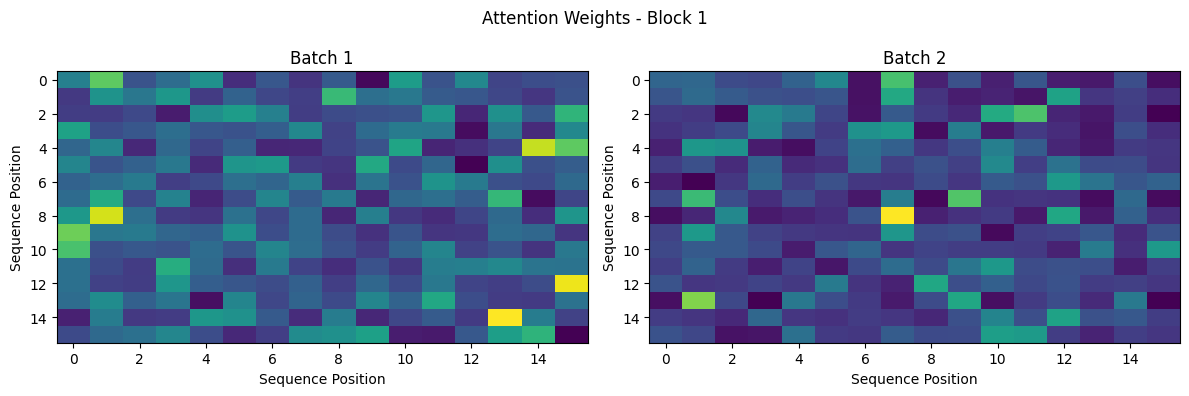
    attention_weights = encoder.get_attention_weights(x, mask=mask)

    # Visualization of attention weights
    for block_idx, weights in enumerate(attention_weights):
        # weights.shape = (batch_size, num_heads, seq_len, seq_len)
        avg_weights = jnp.mean(weights, axis=1)  # Average over heads (seq_len, seq_len)

        fig, axes = plt.subplots(1, batch_size, figsize=(12, 4))
        fig.suptitle(f'Attention Weights - Block {block_idx + 1}')

        for batch_idx in range(batch_size):
            ax = axes[batch_idx] if batch_size > 1 else axes
            ax.imshow(avg_weights[batch_idx], cmap='viridis', aspect='auto')
            ax.set_title(f'Batch {batch_idx + 1}')
            ax.set_xlabel('Sequence Position')
            ax.set_ylabel('Sequence Position')

        plt.tight_layout()
        plt.show()

# Run the test
test_transformer_encoder_visualization()